Sacramento crawl space subfloors face extreme hydrologic swings driven by the American River basin water table, wet winter rain accumulation, and summer irrigation. In low-elevation alluvial soils across…
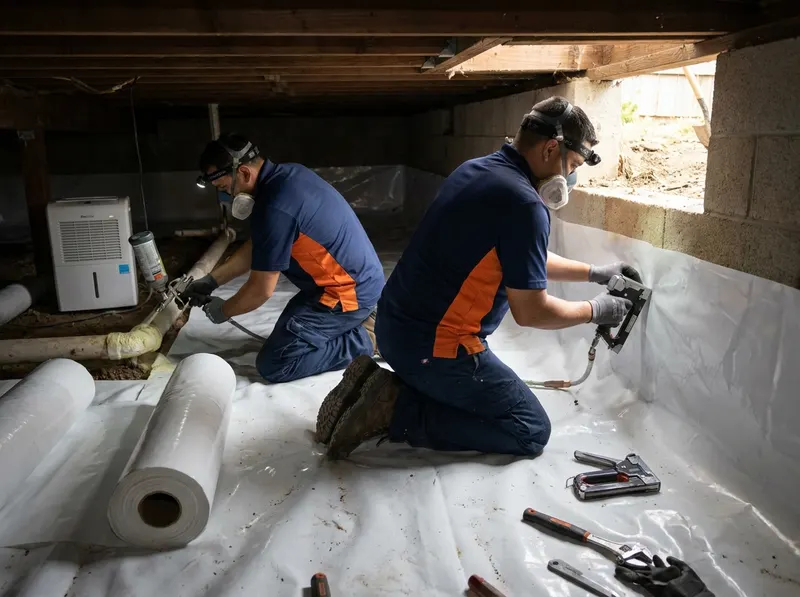
Sacramento crawl space subfloors face extreme hydrologic swings driven by the American River basin water table, wet winter rain accumulation, and summer irrigation. In low-elevation alluvial soils across Pocket-Greenhaven and Natomas, unsealed dirt crawl spaces draw moisture straight upward through capillary action. This persistent humidity creates an optimal microclimate for subterranean termites (Reticulitermes hesperus) and drywood wood-boring beetles that compromise structural subflooring. Simultaneously, raised-foundation craftsman homes and early-twentieth-century bungalows in Midtown, East Sacramento, Curtis Park, and the Fab 40s frequently harbor active roof rat and mouse pathways along mudsills where foundation vents have deteriorated. Unprotected earth crawl spaces measure relative humidity levels exceeding 75%, softening floor timbers and allowing subterranean pests to construct sheltered mud tubes directly into living areas.
A moisture pest barrier functions by isolating the home's framing from raw ground soil through engineered barrier physics rather than recurring insecticide sprays. Technicians grade and rake the crawl floor flat, remove organic wood debris that invites primary decomposers, and roll out multi-ply polyolefin ground sheeting anchored 6 inches above the interior grade line against perimeter stem walls. Overlapping seams are bonded with commercial waterproof mastic tape. For crawl spaces experiencing seasonal hydrostatic pressure, gravity drain channels or crawl-rated sump systems route excess groundwater outward away from footing lines. Foundation vents are retrofitted with galvanized 1/4-inch steel hardware cloth, preventing rodent gnawing while crawl-space dehumidification units stabilize relative humidity below 50%, a threshold where wood rot fungi and silverfish colonies fail to survive.
Decision parameters determine whether a property requires localized moisture remediation or comprehensive encapsulation. If the foundation reveals dry clearance with ambient summer humidity remaining below 55%, installing a baseline 10-mil soil vapor barrier combined with vent exclusion screens successfully stops pest ingress. If subfloor timbers show active fungal surface bloom, swollen subfloor framing, or recurrent winter puddle formation, frequently observed near William Land Park and Tahoe Park properties with dense shade canopies, complete sealed encapsulation with perimeter insulation and dedicated dehumidification is necessary. The trade-off involves upfront material complexity versus ongoing structural decay; partial ground covers lower initial outlay but leave open foundation vent paths through which outdoor river humidity and perimeter pests easily bypass the barrier.
Every job gets a firm, written price after a free on-site visit.
Tell us about your crawl space encapsulation and moisture pest barrier job in Sacramento and we'll send a clear, written quote, usually the same day.
 Tavion Pest Defense