Sacramento residential properties face relentless migratory insect pressure dictated by distinct microclimates, from high groundwater tables near Pocket-Greenhaven and the American River Parkway to dense tree canopies…
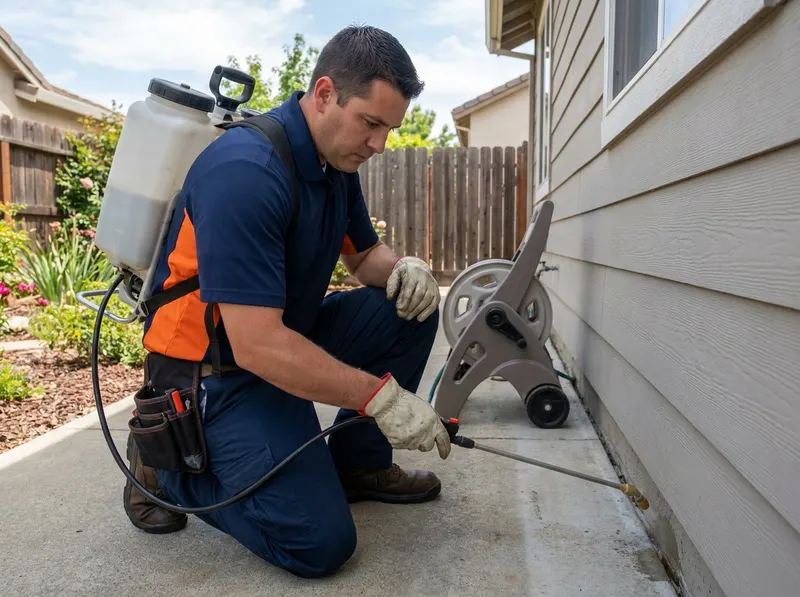
Sacramento residential properties face relentless migratory insect pressure dictated by distinct microclimates, from high groundwater tables near Pocket-Greenhaven and the American River Parkway to dense tree canopies across Land Park and the Fab 40s. During the dry heat of July through September, subterranean pests such as Argentine ants and Turkestan cockroaches seek moisture indoors through hairline gaps in concrete slabs, expansion joints, and irrigation penetrations. Targeted perimeter defense replaces non-specific indoor pesticide aerosoling with barrier physics, establishing a continuous three-foot vertical band up the foundation wall and three feet out across the adjacent soil or perimeter paving. This precise application bonds micro-encapsulated formulations to exterior surfaces, including concrete, stucco, brick, and river rock, preventing pests from establishing harborage within perimeter planter beds or climbing structural walls.
Older raised-foundation bungalows in Midtown, Curtis Park, and Oak Park feature unique architectural vulnerabilities, including unbacked decorative crawlspace vents, settling brick footings, and aged plumbing voids beneath subfloors. A basic structural perimeter spray fails in these homes because rodent activity, particularly roof rats foraging through mature citrus trees, bypasses surface chemicals entirely. Targeted perimeter defense incorporates physical exclusion engineering: high-gauge stainless-steel mesh installation over subfloor vents, expanding foam injected with copper mesh around exterior water spigots, and specialized silicone sealant applied across weep screed transitions. In slab-on-grade developments across Natomas and Tahoe Park, the defense focuses intensely on expansion joints, garage door threshold sweeps, and exterior stucco weep terminations where settling soil creates entry voids larger than one-quarter of an inch.
Selecting targeted perimeter defense over interior fumigation preserves indoor air quality while eliminating chemical exposure for families, pets, and indoor surfaces. A localized interior spot treatment simply kills the individual pests visible inside a pantry or bathroom; it does not resolve the foraging trail extending fifty feet into the yard. Conversely, a perimeter barrier arrests the entire colony by contaminating foraging worker insects as they cross the treated boundary, carrying non-repellent active ingredients back to the subterranean nest. The mechanical trade-off requires maintaining clear clearance: mulch, dense foliage, and stacked firewood within twelve inches of the foundation must be pulled back to ensure uninterrupted surface adhesion of the barrier materials.
Every job gets a firm, written price after a free on-site visit.
Tell us about your targeted perimeter defense job in Sacramento and we'll send a clear, written quote, usually the same day.
 Tavion Pest Defense